> ## Documentation Index
> Fetch the complete documentation index at: https://docs.cartesia.ai/llms.txt
> Use this file to discover all available pages before exploring further.
# Genesys + Cartesia Sonic
> Configure the Genesys TTS Connector integration to synthesize speech with Cartesia
Last verified: 2026-06-11
## Overview
Genesys partners with Cartesia for text-to-speech in a few ways,
one of which is the Genesys TTS Connector integration.
This integration is configured in the Genesys Cloud.
## Prerequisites
* A [Cartesia subscription](https://play.cartesia.ai/subscription) using a paid plan
* A [Cartesia API key](https://play.cartesia.ai/keys); looks like `sk_car_...`
* Access to a Genesys Cloud organization where you can install and configure integrations
## Configure the Genesys TTS Connector with Sonic
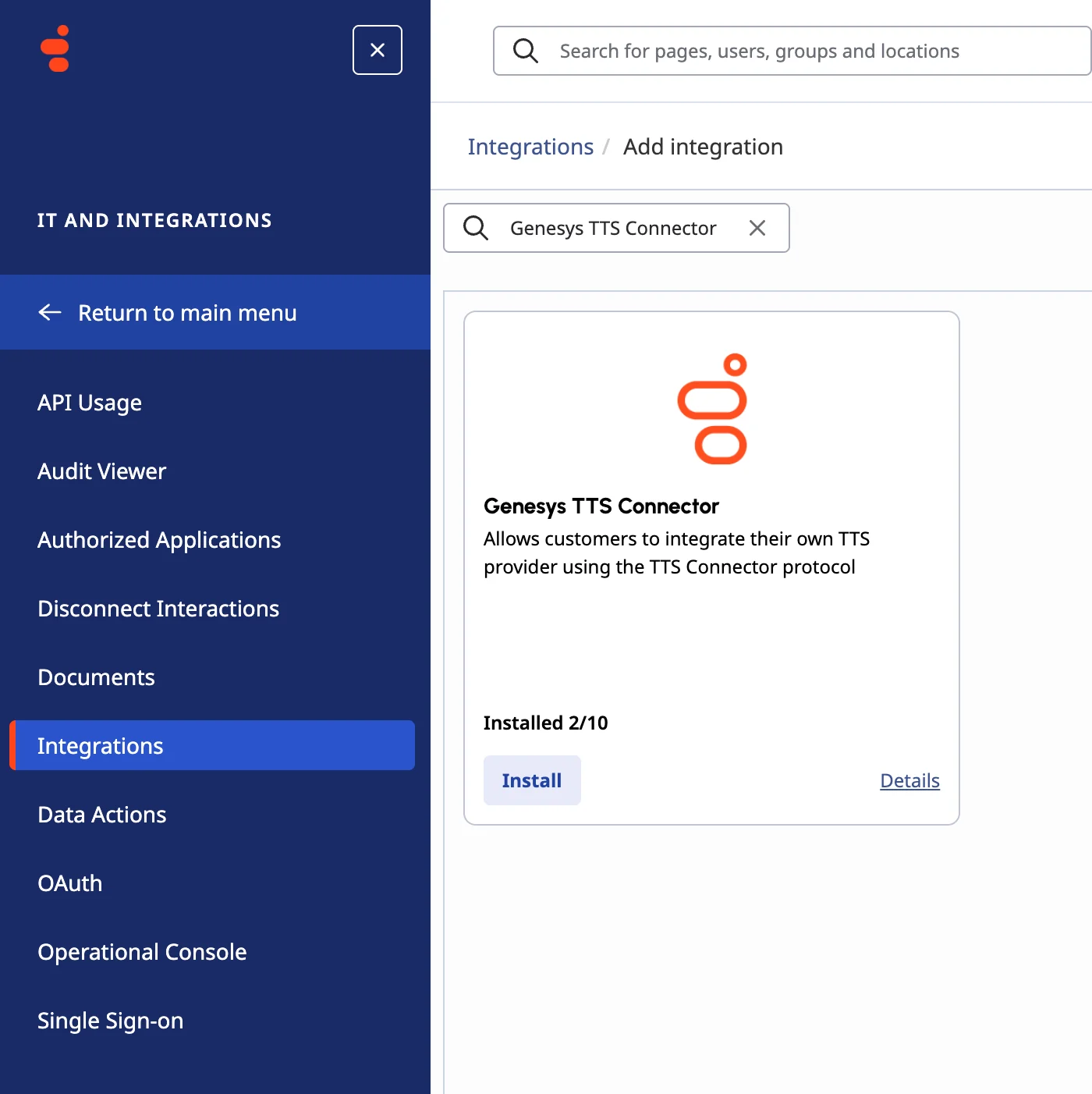
If you did not previously install the integration into your Genesys Cloud organization, install the Genesys TTS Connector now.
If you already installed the integration:
1. Click **Menu** > **IT and Integrations** > **Integrations**.
2. Search for and open the **Genesys TTS Connector** integration.
 In the **Details** tab, enter a unique name for the integration. This can be anything you want, such as `Genesys TTS Connector: Cartesia`.
On the **Genesys TTS Connector: Cartesia** integration page, click **Configuration**.
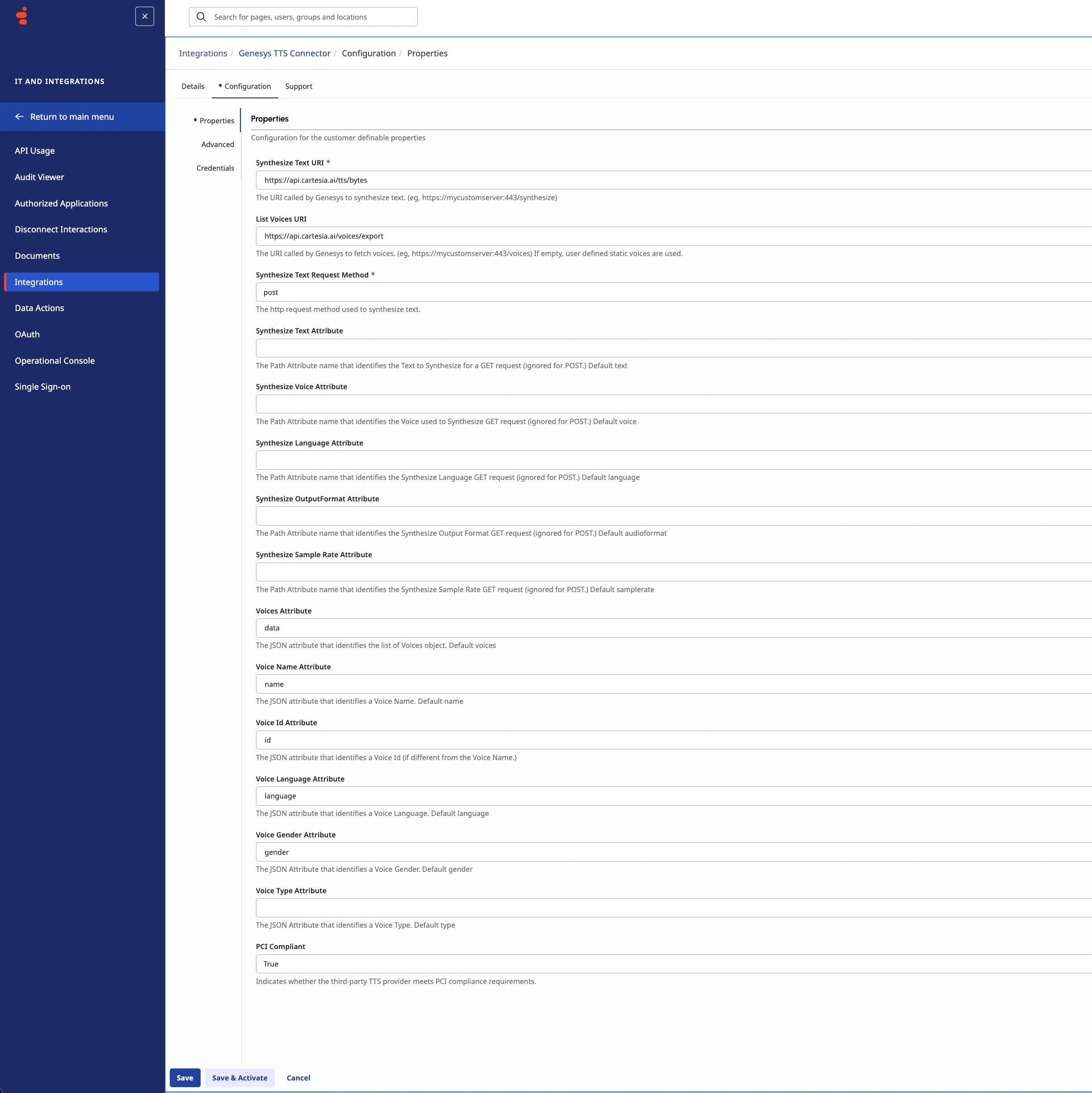
Under **Properties**, enter these values:
| Property name | Value |
| ------------------------------ | --------------------------------------- |
| Synthesize Text URI | `https://api.cartesia.ai/tts/bytes` |
| List Voices URI | `https://api.cartesia.ai/voices/export` |
| Synthesize Text Request Method | `post` |
| Voices Attribute | `data` |
| Voice Name Attribute | `name` |
| Voice Id Attribute | `id` |
| Voice Language Attribute | `language` |
| Voice Gender Attribute | `gender` |
| PCI Compliant | `True` |
* Synthesize Text Attribute
* Synthesize Voice Attribute
* Synthesize Languages Attribute
* Synthesize OutputFormat Attribute
* Synthesize Sample Rate Attribute
* Voice Type Attribute
In the **Details** tab, enter a unique name for the integration. This can be anything you want, such as `Genesys TTS Connector: Cartesia`.
On the **Genesys TTS Connector: Cartesia** integration page, click **Configuration**.
Under **Properties**, enter these values:
| Property name | Value |
| ------------------------------ | --------------------------------------- |
| Synthesize Text URI | `https://api.cartesia.ai/tts/bytes` |
| List Voices URI | `https://api.cartesia.ai/voices/export` |
| Synthesize Text Request Method | `post` |
| Voices Attribute | `data` |
| Voice Name Attribute | `name` |
| Voice Id Attribute | `id` |
| Voice Language Attribute | `language` |
| Voice Gender Attribute | `gender` |
| PCI Compliant | `True` |
* Synthesize Text Attribute
* Synthesize Voice Attribute
* Synthesize Languages Attribute
* Synthesize OutputFormat Attribute
* Synthesize Sample Rate Attribute
* Voice Type Attribute
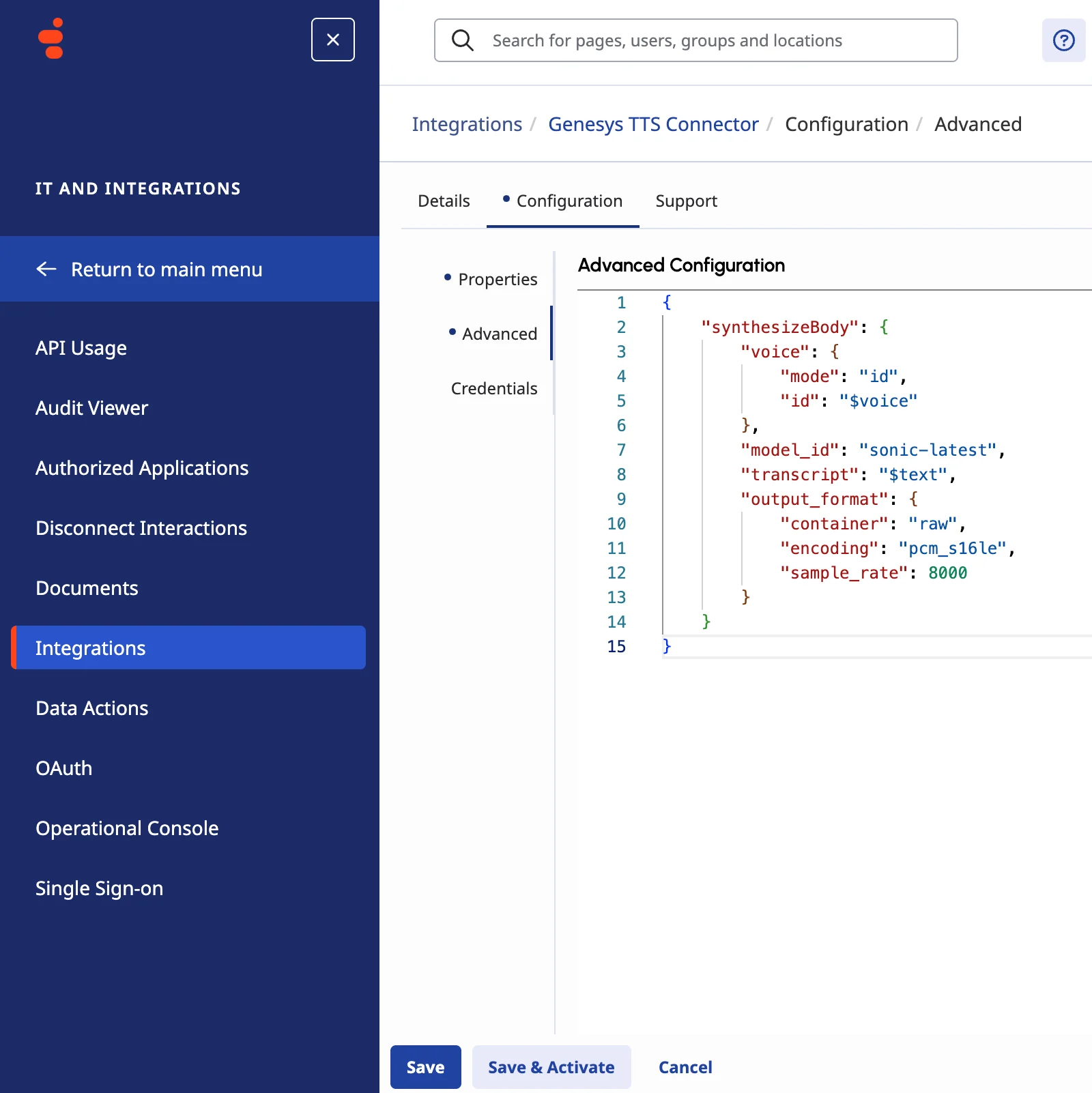
 Click **Advanced**, then copy and paste this as the JSON configuration:
```json theme={null}
{
"synthesizeBody": {
"voice": {
"mode": "id",
"id": "$voice"
},
"model_id": "sonic-latest",
"transcript": "$text",
"output_format": {
"container": "raw",
"encoding": "pcm_s16le",
"sample_rate": 8000
}
}
}
```
1. If these settings generate garbled audio, come back and change `output_format` to match your telephony setup. See [Output Format](/build-with-cartesia/capability-guides/tts-output-audio-format) for details.
2. Before using Sonic in production, change `sonic-latest` to a dated model snapshot from [TTS models](/build-with-cartesia/tts-models/latest) for stability.
Click **Advanced**, then copy and paste this as the JSON configuration:
```json theme={null}
{
"synthesizeBody": {
"voice": {
"mode": "id",
"id": "$voice"
},
"model_id": "sonic-latest",
"transcript": "$text",
"output_format": {
"container": "raw",
"encoding": "pcm_s16le",
"sample_rate": 8000
}
}
}
```
1. If these settings generate garbled audio, come back and change `output_format` to match your telephony setup. See [Output Format](/build-with-cartesia/capability-guides/tts-output-audio-format) for details.
2. Before using Sonic in production, change `sonic-latest` to a dated model snapshot from [TTS models](/build-with-cartesia/tts-models/latest) for stability.
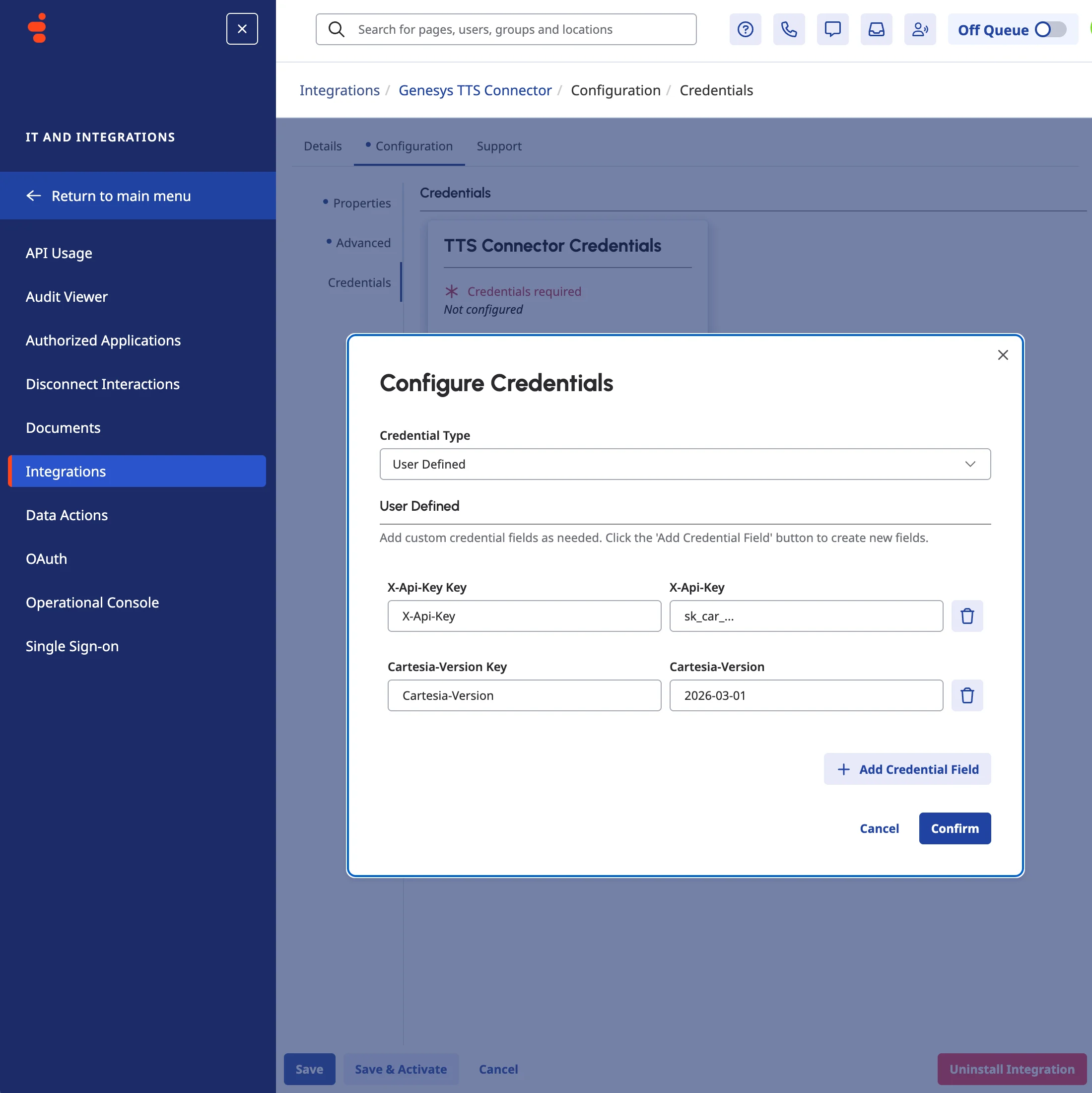
 1. Click **Credentials**, then click **Configure**.
2. In the Configure Credentials dialog, select **Credential Type: User Defined**.
3. Click **Add Credential Field**, then add these fields:
| Key | X-Api-Key |
| ----------- | ------------------------------------------------------------------------ |
| `X-Api-Key` | Your API key from [play.cartesia.ai/keys](https://play.cartesia.ai/keys) |
| Key | Cartesia-Version |
| ------------------ | ---------------- |
| `Cartesia-Version` | `2026-03-01` |
4. Click **Confirm**.
1. Click **Credentials**, then click **Configure**.
2. In the Configure Credentials dialog, select **Credential Type: User Defined**.
3. Click **Add Credential Field**, then add these fields:
| Key | X-Api-Key |
| ----------- | ------------------------------------------------------------------------ |
| `X-Api-Key` | Your API key from [play.cartesia.ai/keys](https://play.cartesia.ai/keys) |
| Key | Cartesia-Version |
| ------------------ | ---------------- |
| `Cartesia-Version` | `2026-03-01` |
4. Click **Confirm**.
 Click **Save & Activate**.
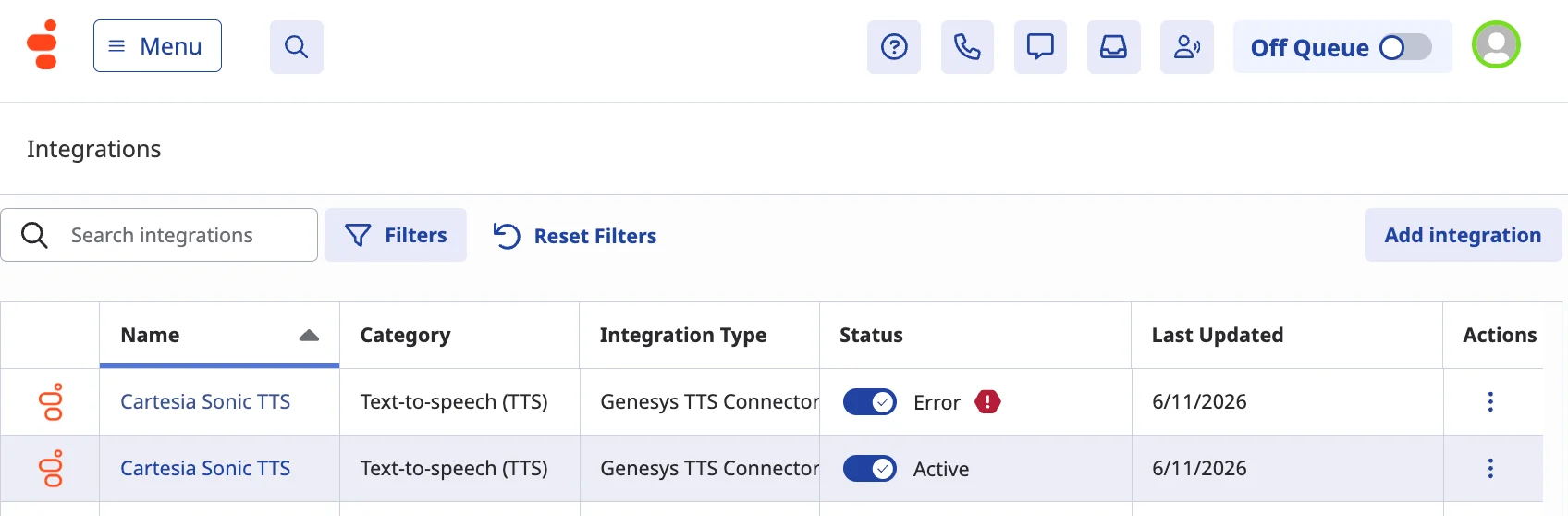
Back on the **Integrations** page, your Genesys TTS Connector integration status should change to **Active** after a few seconds, or show an error.
| Error message | What it means |
| --------------------------------------------- | -------------------------------------------------------------------------------------- |
| You must be logged in to access this endpoint | `X-Api-Key` credential is incorrect |
| Invalid Cartesia-Version header | `Cartesia-Version` credential is incorrect |
| `quota_exceeded` | You need to upgrade your Cartesia subscription |
| Your request was invalid | Something is wrong with **Configuration > Properties** or **Configuration > Advanced** |
Click **Save & Activate**.
Back on the **Integrations** page, your Genesys TTS Connector integration status should change to **Active** after a few seconds, or show an error.
| Error message | What it means |
| --------------------------------------------- | -------------------------------------------------------------------------------------- |
| You must be logged in to access this endpoint | `X-Api-Key` credential is incorrect |
| Invalid Cartesia-Version header | `Cartesia-Version` credential is incorrect |
| `quota_exceeded` | You need to upgrade your Cartesia subscription |
| Your request was invalid | Something is wrong with **Configuration > Properties** or **Configuration > Advanced** |
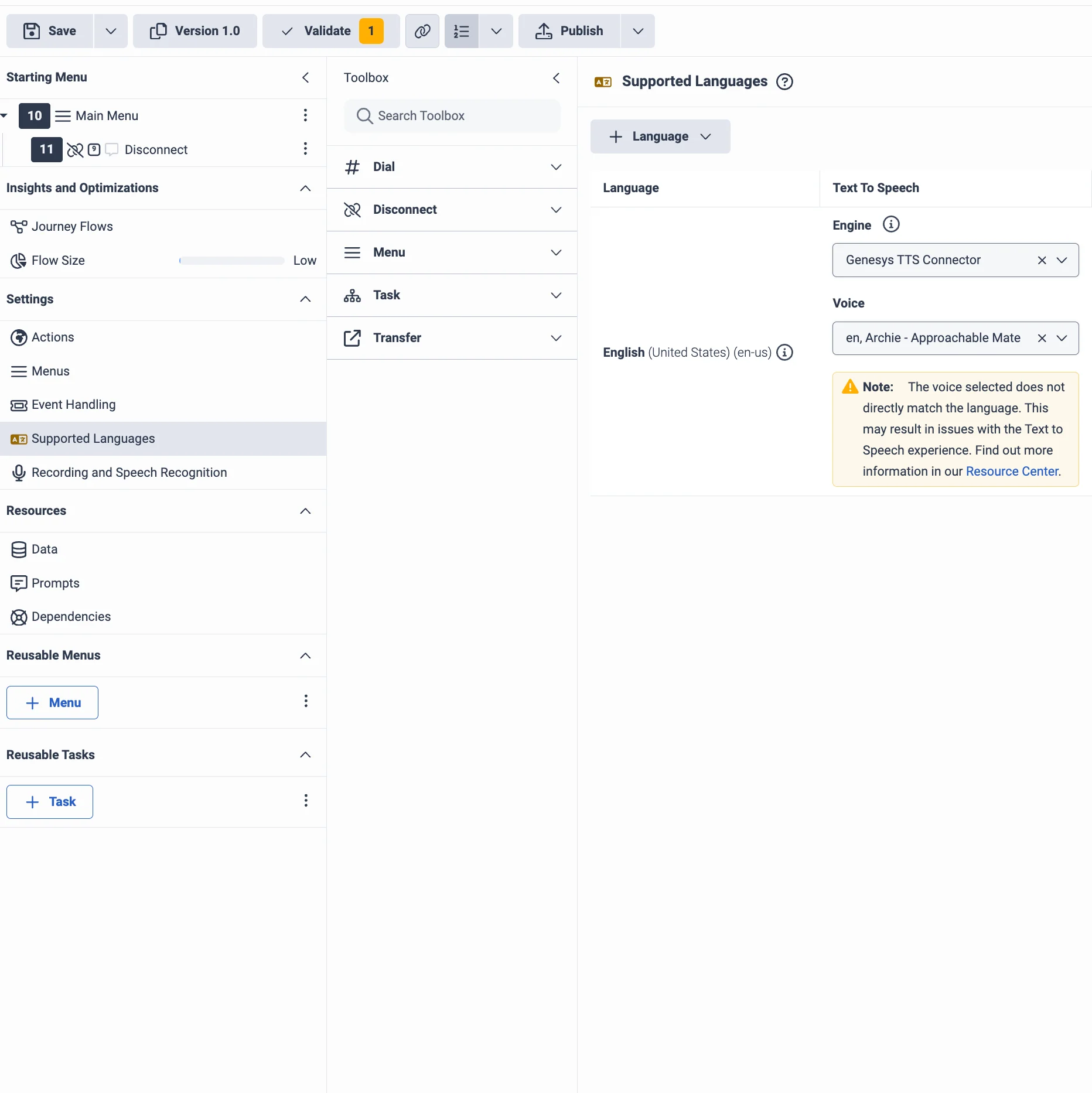
 On the Genesys Cloud **Architect** page, select your newly configured integration and use it for a **supported language**.
You can try out different **voices** on the Architect page, or on [play.cartesia.ai/voices](https://play.cartesia.ai/voices).
See [Choosing a Voice](/build-with-cartesia/capability-guides/choosing-a-voice) for tips.
If audio is garbled, you may need to change your output format to match your telephony setup:
1. Read the [output format](/build-with-cartesia/capability-guides/tts-output-audio-format) guide
2. Go back to **step 5** and try a different `output_format` in **Configuration > Advanced**
On the Genesys Cloud **Architect** page, select your newly configured integration and use it for a **supported language**.
You can try out different **voices** on the Architect page, or on [play.cartesia.ai/voices](https://play.cartesia.ai/voices).
See [Choosing a Voice](/build-with-cartesia/capability-guides/choosing-a-voice) for tips.
If audio is garbled, you may need to change your output format to match your telephony setup:
1. Read the [output format](/build-with-cartesia/capability-guides/tts-output-audio-format) guide
2. Go back to **step 5** and try a different `output_format` in **Configuration > Advanced**
 ## Resources
* [Genesys TTS engine docs](https://help.genesys.cloud/articles/about-text-to-speech-tts-engines/)
* [Genesys TTS connector docs](https://help.genesys.cloud/articles/install-the-genesys-tts-connector-integration/)
* [Cartesia pricing](https://www.cartesia.ai/pricing)
* [Cartesia subscription](https://play.cartesia.ai/subscription)
* [Cartesia API Keys](https://play.cartesia.ai/keys)
* [Finding the right output format](/build-with-cartesia/capability-guides/tts-output-audio-format)
* [Choosing a voice](/build-with-cartesia/capability-guides/choosing-a-voice)
* [Voice library](https://play.cartesia.ai/voices)
## Resources
* [Genesys TTS engine docs](https://help.genesys.cloud/articles/about-text-to-speech-tts-engines/)
* [Genesys TTS connector docs](https://help.genesys.cloud/articles/install-the-genesys-tts-connector-integration/)
* [Cartesia pricing](https://www.cartesia.ai/pricing)
* [Cartesia subscription](https://play.cartesia.ai/subscription)
* [Cartesia API Keys](https://play.cartesia.ai/keys)
* [Finding the right output format](/build-with-cartesia/capability-guides/tts-output-audio-format)
* [Choosing a voice](/build-with-cartesia/capability-guides/choosing-a-voice)
* [Voice library](https://play.cartesia.ai/voices)